TABLE OF CONTENTS
1. INTRODUCTION
1.1. General
1.2. Rationale
2. PRINCIPLES
2.1. Seasonal approach
2.2. Hydrological data
2.3. Agricultural data
2.4. Soil strata
2.5. Water balances
2.6. Drains, wells, and re-use
2.7. Salt balances
2.8. Farmers' responses
2.9. Annual input changes
2.10 Output data
2.11 Other users' suggestions
3. WATER BALANCE EQUATIONS
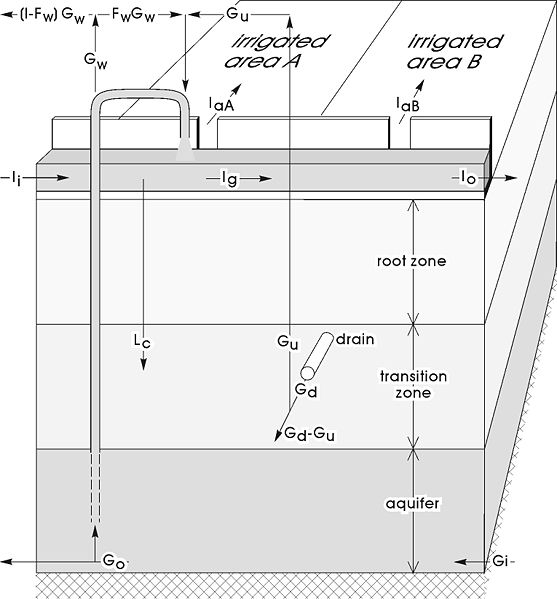
3.1. The reservoir concept
3.1.1. The surface reservoir
3.1.2. The root zone
3.1.3. The transition zone
3.1.4. The aquifer
3.1.5. Top soil water balance
3.1.6. Sub-soil water balance
3.1.7. Agronomic water balance
3.1.8. Geo-hydrologic water balance
3.1.9. Overall water balance
3.2. Model calculations water balance top soil
3.3. Capillary rise and actual evapo-transpiration
3.3.1. Depth of the water table and capillary rise factor
3.3.2. Potential evapo-transpiration and moisture deficit
3.3.3. Apparent capillary rise and actual evapo-transpiration
3.3.4. Capillary rise
3.4. The subsurface drainage
3.5. Model calculations water balance transition zone
3.6. Model calculations depth of the water table
3.7. Irrigation efficiencies and sufficiencies
4. SALT BALANCE EQUATIONS
4.1. Change in salt content
4.2. Salt leaching
4.3. Salt balances under full cropping rotation
4.3.1. Above the soil surface
4.3.2. Root zone
4.3.3. Transition zone
4.3.4. Aquifer
4.3.5. Salt concentration of drain and well water
4.4. Salt balances under zero cropping rotation
4.4.1. Above the soil surface
4.4.2. Root zone
4.4.3. Transition zone
4.5. Salt balances under intermediate cropping rotations
4.5.1. Types of irrigation/cropping rotation
4.5.2. Part of the area permanently non-irrigated, Kr=1
4.5.3. Part of irrigated area permanently under A crop(s)
4.5.4. Part of irrigated area permanently under B crop(s)
5. AREA FREQUENCY DISTRIBUTION OF SOIL SALINITY
6. FARMERS' RESPONSES
6.1. Reduction of irrigated area when salinization occurs
6.2. Reduction of irrigation when water logging occurs
7. ALPHABETICAL LIST OF ALL SYMBOLS USED
8. USER MENU
8.1. The main menu
8.1.1. The input menu
8.1.2. Calculations
8.1.3. The output menu
8.2. Editing the input
8.3. Inspecting the output
8.3.1. Soil salinities root zone
8.3.2. Other salinities
8.3.3. Drain/well flow, water table
8.3.4. Percolation
8.3.5. Capillary rise
8.3.6. Canal/field irrigation, bypass
8.3.7. Irrigation sufficiencies/efficiencies
8.3.8. Crop area fractions, rotation key
8.3.9. Scroll through the entire output file
9. LIST OF SYMBOLS OF INPUT DATA
10 LIST OF SYMBOLS OF OUTPUT DATA
11 CASE STUDY EGYPT
11.1. Introduction
11.2. Calibrating the leaching efficiency
11.3. Determining the natural subsurface drainage
11.4. Simulating effects of varying drain depths
11.5. Reconstructing the initial conditions
12 CASE STUDY INTERACTIONS
12.1. Introduction
12.2. Irrigation efficiency, sufficiency
12.3. Irrigation and soil salinity
12.4. Conclusion
13 REFERENCES