FAQ's   (frequently asked questions)   and   answers

Since the opening of the website a number of questions about soil problems, reclamation, drainage systems, irrigation, land and water management, and statistics have reached me.                            
Sometimes I was unable to provide an adequate answer.

However, there were questions I could categorize and answer collectively through generalized texts that were made for the occasion.

Twelve of the categories are dealt with below in PDF documents that can be viewed and saved on your computer provided you have got an Acrobat Reader installed.

More papers can be found on the articles page. Other publications may follow in due course.

Software
& models

Articles
& manuals

Reports
& cases

Home page


The following 16 questions were frequently asked:

     
1 - What is waterlogging? (This is probably the most frequently asked question}                            

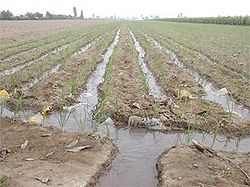
     In agriculture, waterlogging means that the soil is considered too wet to cultivate crops profitably (except lowland rice).
Waterlogging can be stagnation of water on top of the soil surface and/or the presence of a high water table inside the soil (at a depth of say 0.7 m on average).
Surface waterlogging can be seen as a flood control problem or a surface drainage problem.
Subsurface waterlogging can be tackled by a subsurface drainage system.
As an alternative one may opt for another kind of land use.
More information can be found in an article on Drainage Criteria and in a paper on world wide cases of Drainage Systems.
See also Wikipedia (watertable control) or WaterWiki (land drainage)

 
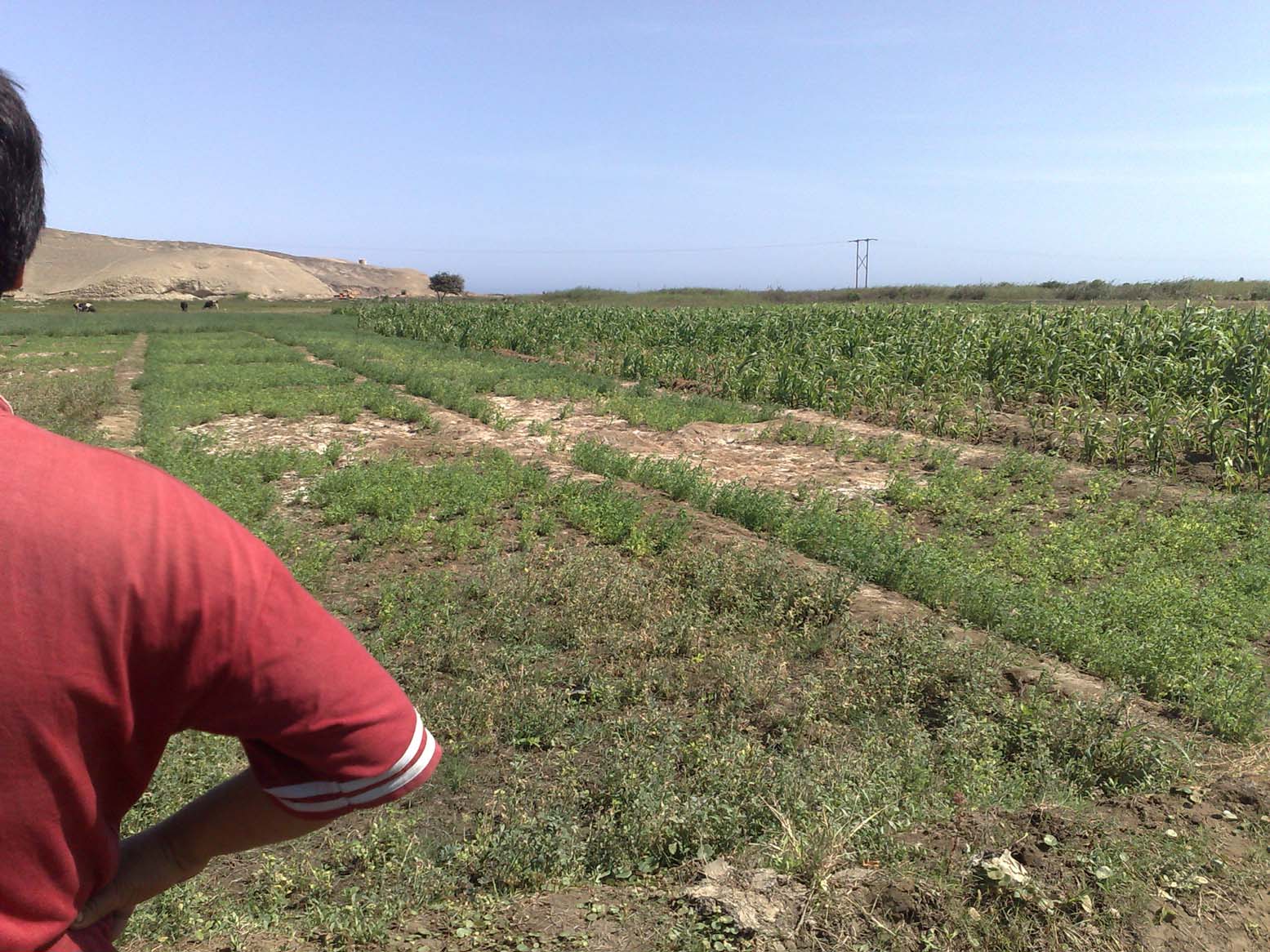
2 - What are saline and salty soils, how do they originate, where are they found, what is their problem, how can the problem be solved?

     This is the paper on soil salinity
     There is also a programmed self-help exercise on water and salt balances and leaching (reclamation) of a saline, salty and sodic, soil in Chacupe, Peru. Soil salinity, sodicity and alkalinity are analysed: Chacupe case study
     See also "Salinity control" in Wikipedia

 
3 - What are alkali, alkaline sodic and acid sulphate (sulfate) soils (cat clays), how do they originate, where are they found, what is their problem, how can the problem be solved?

     This is a paper on soil alkalinity, sodicity and acidity
A report on acid sulfate soils in the island of Pulau Petak near Bandjermasin, South Kalimantan, Indonesia, can be viewed on line.

 
4 - What kind of drainage systems are applicable under what conditions?

     It is difficult to give a generally valid answer to this question, but the paper on surface and subsurface drainage systems gives a summary of practical experiences with different methods under varying agro-climatologic conditions.

 
5 - How can I calculate drainage discharge needs and irrigation/leaching requirements for salinity control using water and salt balances without resorting to simulation models like SaltMod and SahysMod?

     The answers may be found in a lecture note on Drainage for Agriculture presenting Drainage and Hydrology/Salinity, Water and Salt balances.

Free of obligations on either side
     
6 - What is the development of river salinity in downstream direction when, in arid and semi-arid regions, the salty river water is used for irrigation of agricultural land and the drainage flow and effluent are returned to the river, and what are the effects on soil salinity and how can eventual problems of salty soils be tackled?

     This is a paper on river salinity.
The accompanying Excel spreadsheet can be downloaded.
Further a powerpoint presentation is available. You may download it or otherwise see it on-line.


7 - What is the influence of land slope on the spacing of subsurface drains?

     The answer is: for drain spacing calculations the slope of the land has little influence. For this purpose, sloping lands may considered as if they were flat.
This is a paper with mathematical explanations

 
8 - How can hydraulic conductivity (permeability) of the soil be measured and determined?

     The measurement of hydraulic conductivity can be done in the laboratory or in the field, above or below the water table, using small scale (auger hole method, infiltration method) and large scale methods (e.g. using drainage data in existing experimental fields or in farm land).
A full description is given in the chapter "Measurement of hydraulic conductivity of soils".
See also the table of contents on line.
For well pumping tests to determine aquifer hydraulic properties see the WellDrain model (software page).

 
9 - Drain spacing equations for horizontal tile/pipe drains are well known. Can subsurface drainage also be done by (tube)wells and how can the required spacing be calculated?

     The calculation of well spacings for subsurface drainage can be done with the WellDrain program (see software page). The theory behind it is discussed in the paper Well spacing equations.
For well pumping tests to determine aquifer hydraulic properties see the WellDrain model (software page).

 
10 - What is the optimimum depth of the water table and how can we develop suitable drainage criteria to design a subsurface drainage system

     This is the lecture note on Agricultural Drainage criteria.
The table of contents can be seen on line.

Questions are good, problems are not
 
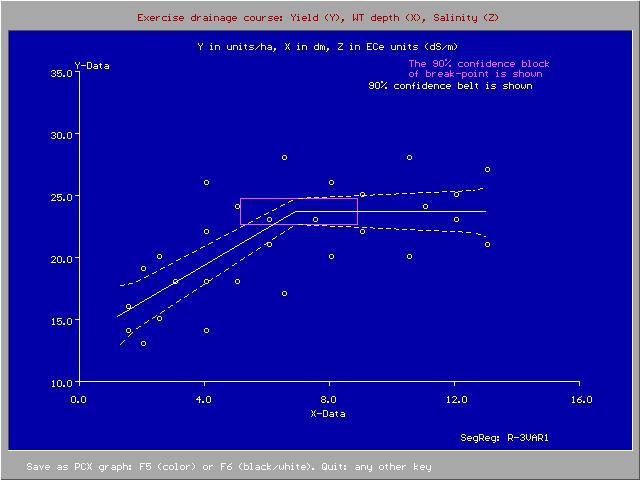
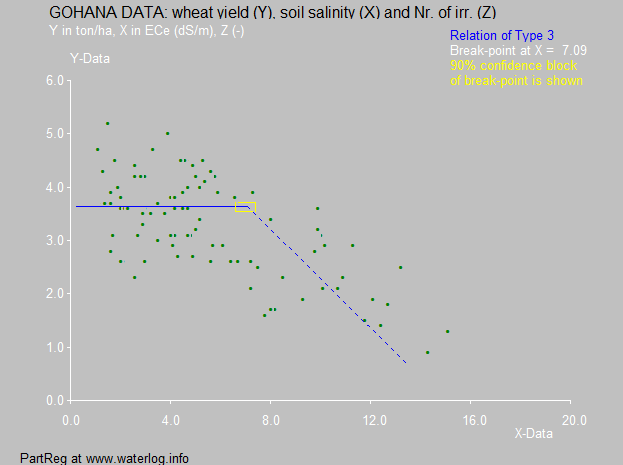
11 - What are the principles of linear regression analysis (used in the SegReg program, see Software page) and how are confidence statements and intervals determined. What is breakpoint (break point), threshold, and coefficient of explanation (determination)?

     This is the lecture note on regression analysis.
The table of contents can be seen on line.

 
12 - What are the principles of cumulative frequency analysis and (discontinuous) probability distributions (used in the CumFreq program, see Software page), and what to do if there is a discontinuity? What is return period and how reliable is it?

     This is the lecture note on frequency analysis.
The table of contents can be inspected here.

 
13 - The SegReg model (see Software page) provides confidence intervals of the break-point in segmented linear regression analysis to test its statistical significance. Is it necessary to additionally perform an analysis of variance (ANOVA) and F-test and how is this done?

     This is the Anova paper

 
14 - What envelope materials (filters, wraps) are used for pipe drains?

     This is a pdf file made of scannned pages on the subject taken from an ILRI publication.

 
15 - What is tidal irrigation and how does it work?

     This is a paper in tidal irrigation of date palms in the Abadan Island in SW Iran.

 
16 - How is the river and surface water pollution tackled in The Netherlands?

     I am not a lawyer nor a specialist on pollution with organic compounds. Yet I made a summary of the Dutch "Law Pollution Surface Water" to the best of my ability. This is the summary.
Further a powerpoint presentation of the summary ("summary of the summary") can be downloaded or viewed on-line.


or a genuine interest?


For more papers proceed to the articles page or else return to the home page.                                                                                                                                                                                
eXTReMe Tracker