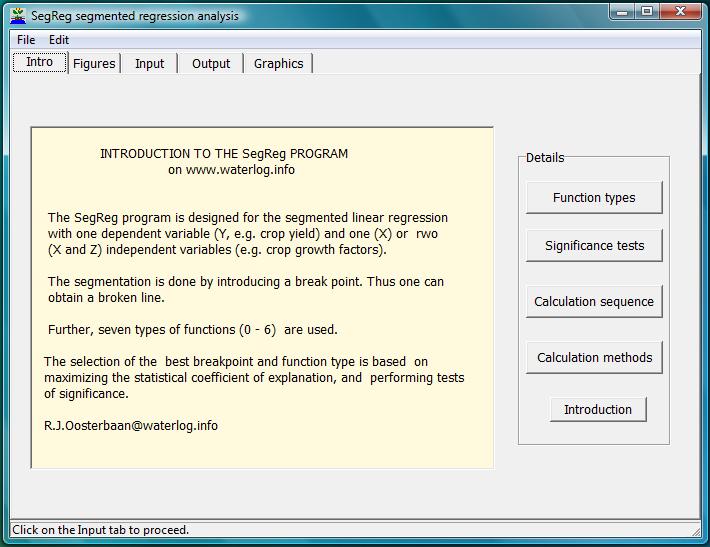
The model comes with various explanations like programmed function types, calculation methods, and application of significance tests.
Example Type 3:
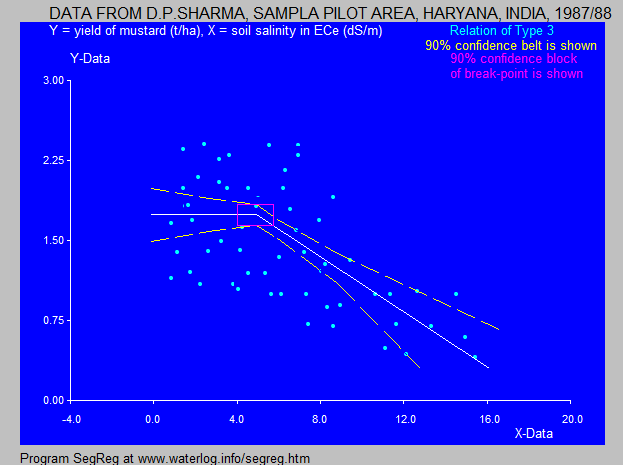
The SegReg model is designed for segmented (piecewise) linear regression with breakpoint (threshold). The application program can be used for salt tolerance of crops or the tolerance to shallow watertables.
The calculator clarifies the crop response and demonstrates the resistance to high soil salinity or water level. This Type 3 is similar to the Maas-Hoffman model having a plateau.
Example Type 3 with extended horizontal line (plateau) using the same data as above in the PartReg software application instead of SegReg.
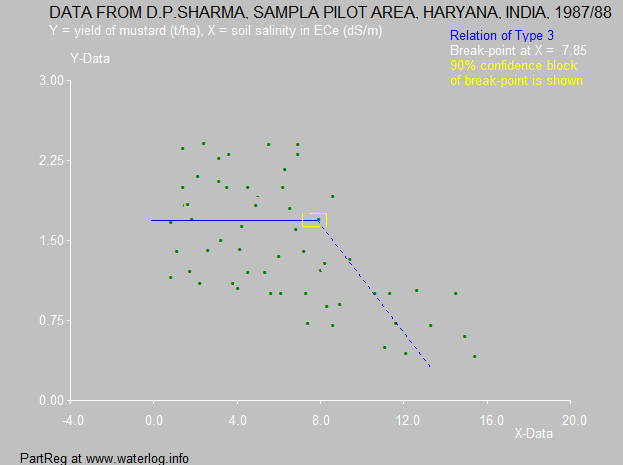
According to this calculator model, the salt tolerance of mustard is almost ECe=8 dS/m. After this threshold (breakpoint, knot)the yield reduces. In other words, from this application program it can be deduced that the crop resists salinity up to 8 dS/m while up to 8 dS/m there is no negative effect.
Example Type 4:
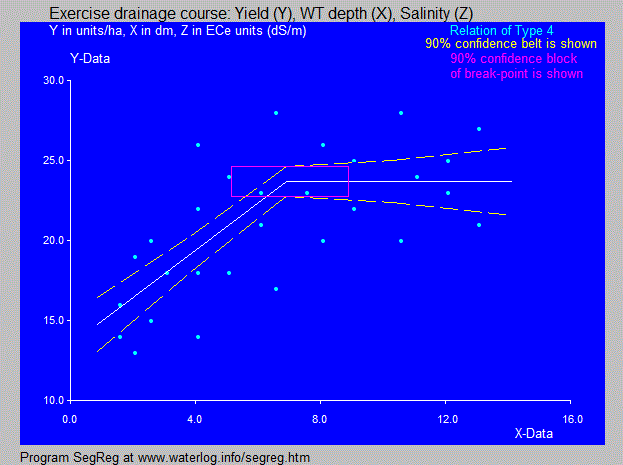
The crop tolerates a depth of the water table of 7 dm.
The Segreg software calculator is an application (app) made to detect different segmented models, like Type 4 with a plateau in the above figure.
This type is an inverted Type 3 or an inverted Maas-Hoffman model. The breakpoint is also called knot.
Example Type 5:
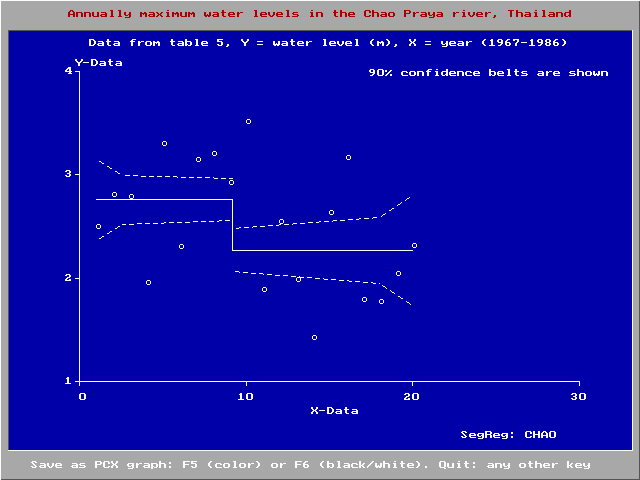
In year 9 (1976) a dam was contstructed in the river
The Segreg application (app) is a calculator made to program different segmented models, for example Type 5 in the figure.
Part 2 for the polynomal case of 1 dependent variable (Y) and 2 independent variables (X and Z)
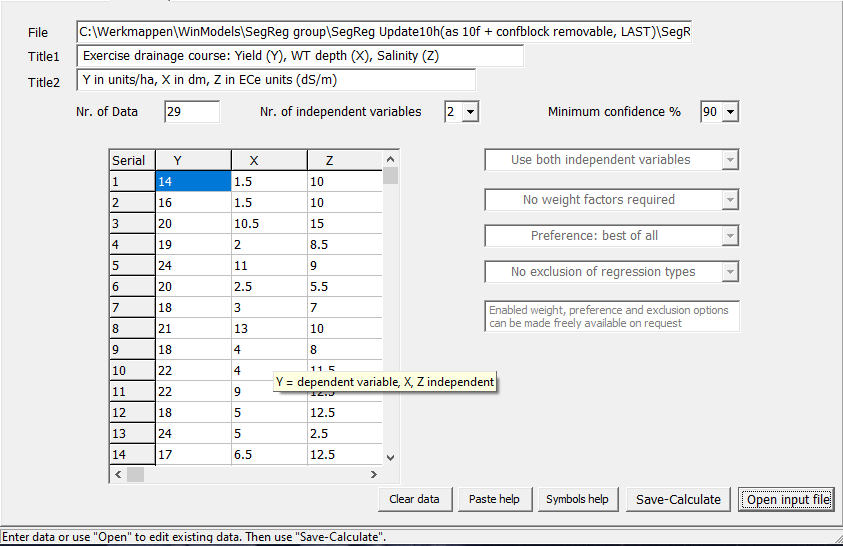
Screen print of the input menu for the polynomial case (1 dependent variable (Y) and 2 independent variables (X and Z).
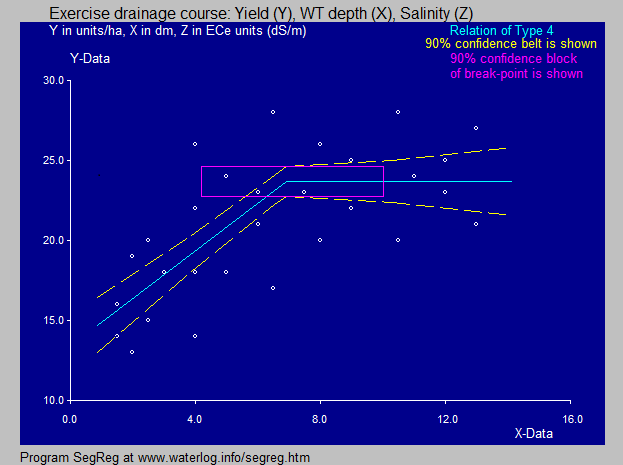
The SegReg program found that the 1st independent variable (X) has a higher coefficient of explanation than the second (Z). Therefore the first segemented regression is made for X.
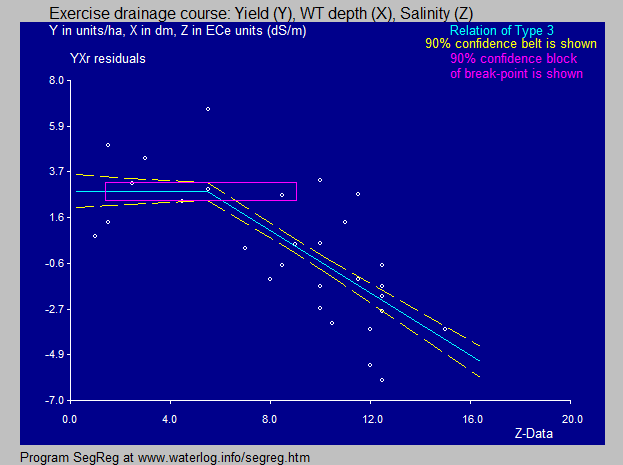
The the residuals of Y after the regression on X are used with a segmented regression on the second variable (Z).
The mathematical combination of the first and second analysis yields equations of the type Y = A.X + B.Z + C (polynomial)